
$20,000.00 Original price was: $20,000.00.$16,000.00Current price is: $16,000.00.
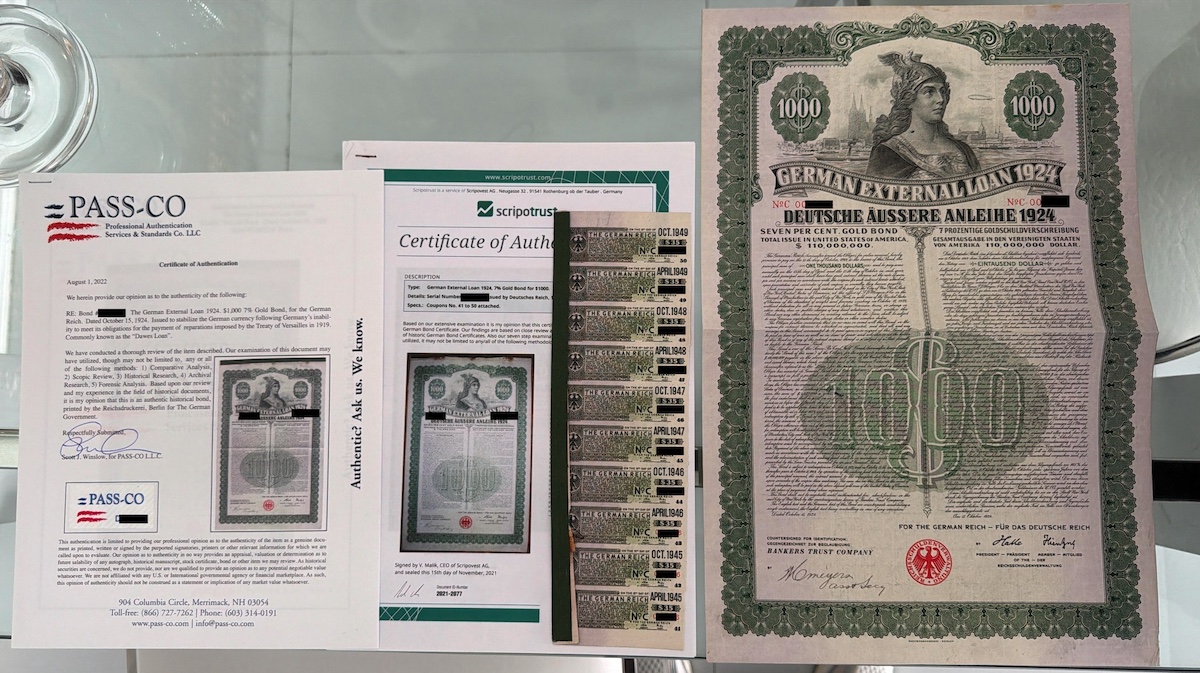
This document is an original German External Loan of 1924, issued in the amount of $1,000 United States Gold Dollars, bearing 7% annual interest. Commonly referred to as the Dawes Loan, this bond represents one of the most significant international financial instruments of the post–World War I era.
Issued following the implementation of the Dawes Plan, the 1924 German External Loan was designed to stabilize the German economy after hyperinflation and to restructure reparations obligations imposed by the Treaty of Versailles. The loan was underwritten and distributed internationally, with bonds issued in multiple currencies, including U.S. dollars, to attract foreign capital—particularly from American investors.
Issuer: German Reich (Government of Germany)
Year of Issue: 1924
Denomination: $1,000 U.S. Gold Dollars
Interest Rate: 7% per annum
Type: External Sovereign Bond
Security: Backed by designated German revenues and international banking guarantees
Coupon Structure: Originally issued with multiple detachable interest coupons (some examples survive with partial or full coupon sheets)
The bond is richly engraved in classic early-20th-century style, featuring:
An allegorical female figure symbolizing Germany
Ornate green and black border engraving
Multilingual text and detailed legal clauses
Official seals, signatures, and issuing bank countermarks
Its visual quality makes it highly desirable not only as a financial artifact, but also as a museum-grade piece of historical ephemera.
Examples of this bond are frequently accompanied by third-party authentication certificates from recognized historical document authentication firms, confirming originality and period issuance. Authentication enhances collectibility and archival value.
Today, the 1924 German External Loan bond is valued primarily for its:
Historical importance
Association with global post-war financial restructuring
Scarcity in well-preserved condition
Appeal to collectors of sovereign bonds, scripophily, and 20th-century financial history
This bond is not sold as a redeemable financial instrument, but as a historical collectible and archival document.